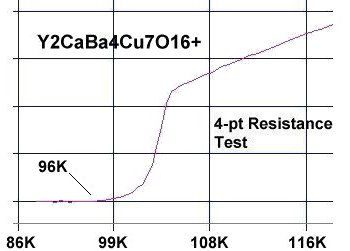
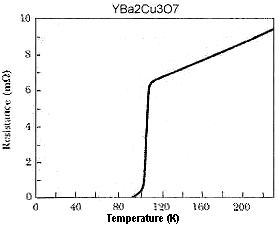

Superconductors.ORG reports the discovery of a new YBCO variant with Tc of 96K and higher current-carrying capability than standard (91K) YBCO. A plot of the material's resistance-vs-temperature response (R-T) is shown above alongside a standard YBCO plot. The chemical formula of this compound is Y2CaBa4Cu7O16+.
 |
Though prior research has found that calcium doping depresses the Tc of YBCO, in
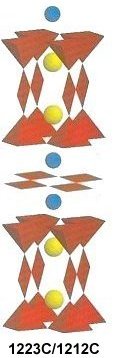
this new formulation Tc is increased. This is due to an additional layer being added to the unit cell.
Unlike Super YBCO, heavy rare earths are not required. The new formulation is neither 123, 124 nor 247; but rather, an
intergrowth of 1212C and 1223C structures.
The claim of a higher current-carrying capability in this material arises from a 2004 report by Brookhaven National Laboratory researchers who found that doping YBCO with calcium increases the amount of current the material can carry. BNL scientists found that calcium substitution changes the atomic structure at the grain boundaries, providing additional “pathways” for electric charge carriers to pass. It was determined that calcium doping can increase the current across the grain boundary by as much as 35 percent. According to Brookhaven physicist Robert Klie, “Where the atoms are tightly packed, a calcium atom replaces a larger barium atom, relieving the strain. Oppositely, in loosely packed areas, the calcium replaces a smaller copper atom, which relaxes strained areas that are nearby.” |
Like most "novel" materials, this compound displays unusual magnetic properties. With an imposed field of 1.00 Oe, the Los Alamos Superconductivity Lab showed the onset of diamagnetism near 89.5K (see below plot). Though the resistive Tc has increased, the magnetic Tc remains the same as that of Y123.

Synthesis of the material was by the solid state reaction method. Stoichiometric amounts of the below precursors were mixed, pelletized and sintered for 11 hours at 890C. The pellet was then annealed for 10 hours at 500C in flowing O2.
Y2O3 99.99% (Alfa Aesar) BACK to "News" page at Superconductors.ORG